Every year, organisations develop innovative approaches to common challenges. Access improves, waiting lists reduce, teams work more effectively, and patient experience benefits. Naturally, others look to replicate that success. There is value in learning from what has worked elsewhere. Shared learning helps organisations avoid reinventing the wheel and can accelerate improvement efforts. But there is a difference between learning from success and attempting to replicate it. What works in one organisation may not work in another, even when the challenge appears identical.
The reason is simple. Healthcare systems are shaped by people, relationships, culture, history, leadership, workforce pressures and local circumstances. These factors influence how problems emerge and how solutions take hold. Improvement does not happen in isolation from the environment in which it sits.
Looking beyond the solution
When organisations face operational pressure, it can be tempting to focus on finding the answer as quickly as possible. A new process. A new pathway. A new model. A proven approach from elsewhere.
But sustainable improvement starts with understanding the factors that created the challenge in the first place. Without that understanding, there is a danger that organisations address symptoms rather than causes.
Even where improvements are achieved, they can be difficult to sustain if the underlying conditions remain unchanged. However, understanding the problem is only part of the picture. The challenge lies in developing solutions that are meaningful, practical and workable within the local context.
Ownership matters
One of the strongest predictors of sustainable change is ownership. When teams are involved in shaping improvements themselves, they are far more likely to understand the rationale, adapt to challenges and maintain momentum over time. This does not mean every organisation must start from scratch. There is enormous value in sharing proven approaches, lessons learned and practical experience from other settings. The difference is how those ideas are used.
“Successful approaches from elsewhere are often better viewed as seeds and accelerators rather than templates for lift and shift implementation. They help organisations move more quickly, avoid common pitfalls and build on existing learning, but they still need to be adapted, tested and refined within the local context”
Supporting change through difficult stages
Improvement rarely follows a straight line. Every new approach encounters obstacles. Assumptions are challenged. Unintended consequences emerge. What looked promising on paper can feel very different in practice. Too often, support ends once a solution has been designed. Yet this is often the point at which organisations need support most.
The reality is that sustainable improvement depends on working through the inevitable snags and flaws that emerge during implementation. Processes need refining. Approaches need adjusting. Teams need space to learn what works and what does not.
The strongest solutions are not usually those that are perfect from the outset. They are the ones that have been tested, adapted and improved through experience.
Balancing the needs of the whole system
Sustainable improvement is also about balance. What works operationally must work for patients. What improves access must remain manageable for staff. What delivers short term gains must support longer term sustainability.
The strongest improvements recognise that different stakeholders experience change in different ways. Lasting solutions are those that balance these competing pressures and create benefits that can be maintained over time.
A facilitative approach to improvement
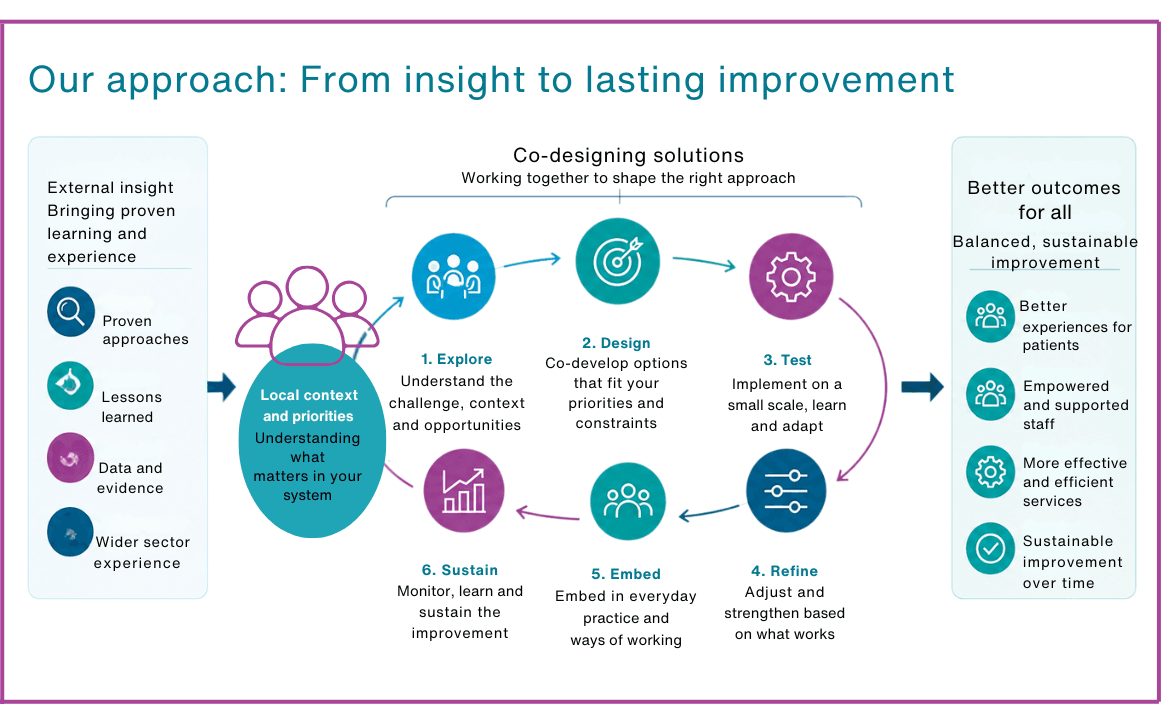
At Xytal, we see our role as assisting and facilitating locally developed responses rather than prescribing solutions from the outside.
Our role is to help teams understand their challenges, explore possibilities, learn from proven approaches and develop solutions that fit their local context.
That means combining external insight with local knowledge, supporting teams through implementation, refinement and embedding, recognising that sustainable improvement is rarely achieved through replication alone.
Lasting change needs to be developed, refined and embedded from within, ideas are shaped, tested and owned by the people closest to the work.