The following case study has been anonymised, and a pseudonym has been used to protect the participant’s identity.
Background
Daniel joined the Senior and Aspiring Leaders Leadership Programme, a seven month leadership development programme delivered through a partnership between Xytal and Suffolk and North East Essex Integrated Care Board (ICB).
Working as a GP in primary care, he had not previously held a formal leadership role and considered himself to be early in his leadership journey. While interested in leadership and improvement, he was still exploring what leadership might look like for him in the future.
The programme provided an opportunity to learn alongside colleagues from across healthcare, develop leadership skills and gain experience of working on a real improvement project.
The challenge
Many participants were already leading teams, services and large scale change programmes across the health and care system. As a GP working primarily within general practice, Daniel was interested in understanding how leadership operates across organisational boundaries and whether he could see himself contributing at that wider system level in the future.
He was keen to develop his confidence, broaden his understanding of the wider system and learn from colleagues with different experiences and perspectives.
Learning from others
One of the most valuable aspects of the programme for Daniel was the opportunity to learn alongside colleagues from different areas and levels of seniority.
The Action Learning Sets became one of the most valuable elements of the programme. They provided a trusted space for participants from different organisations and professional backgrounds to reflect on challenges, test ideas and learn from one another’s experiences. For Daniel, these conversations helped him gain a clearer understanding of what leadership looks like in practice and provided valuable insight into the realities of leading change across complex systems.
Developing confidence and perspective
One of the most significant changes for Daniel was how he viewed both leadership and his own potential role within it.
Spending time with colleagues from across healthcare helped him realise that leadership is not limited to people in formal positions or senior roles. Hearing others openly discuss their experiences, challenges and learning made leadership feel more attainable and helped him recognise the contribution he could make himself.
As the programme progressed, Daniel became increasingly comfortable sharing his views, contributing to discussions and engaging with different perspectives. He developed greater confidence in expressing his opinions, even when there was disagreement or when decisions ultimately took a different direction.
“I’m definitely more confident in voicing my opinions.”
The experience encouraged him to think more broadly about his role within the wider system and the value of contributing beyond the boundaries of his day-to-day work.
Applying learning in practice
The programme influenced how Daniel approached leadership and communication.
He recognisd that effective leadership does not always require a single, consistent style. Through discussions and reflection, he came to appreciate the importance of adapting approaches depending on the situation, the people involved and the challenges being faced.
He developed a greater appreciation for active listening. Rather than rushing to respond or offer solutions, Daniel reflected on the value of allowing people time to fully explain their concerns and perspectives before stepping in.
He found that listening more carefully often led to more productive conversations and better outcomes. Ideas explored through action learning discussions influenced how he approached conversations locally, helping him apply reflection and learning directly to practice.
Applying learning to improvement work
As part of the programme, Daniel worked with colleagues from different areas on a project focused on improving an area of patient care that involved both primary and secondary care services.
The project required the team to gather and analyse data, engage stakeholders from across the system and identify opportunities to improve consistency and reduce unnecessary workload.
Working through the DMAIS framework, the group reviewed baseline information, explored the factors contributing to variation in practice and developed recommendations for improvement. Their work highlighted opportunities to improve the quality of information being shared between services, strengthen adherence to clinical guidance and reduce avoidable activity across the system.
The project also reinforced the importance of involving the right people from the outset. Daniel reflected on the value of engaging stakeholders early, understanding different perspectives and developing solutions collaboratively rather than in isolation.
For Daniel, the project provided practical experience of leading improvement in a complex environment. It strengthened his understanding of how change happens in practice and highlighted the importance of balancing data, clinical insight and stakeholder engagement when developing sustainable solutions.
Understanding the wider system
The Senior and Aspiring Leaders Leadership Programme strengthened Daniel’s understanding of the wider system. Working alongside colleagues from different areas gave him greater insight into the pressures, priorities and challenges experienced elsewhere. For someone working in primary care, this broader perspective was particularly valuable.
It helped reinforce the understanding that while different parts of the system may experience challenges differently, many of the underlying frustrations and ambitions are shared.
This greater awareness of the wider system strengthened his appreciation of the importance of collaboration across organisational boundaries and the value of building relationships beyond his immediate area of work.
The experience reinforced that many of the challenges facing healthcare systems cannot be solved by a single team or organisation acting alone. It highlighted the importance of collaboration, shared understanding and building relationships across traditional organisational boundaries.
Outcomes
Through the programme, Daniel developed:
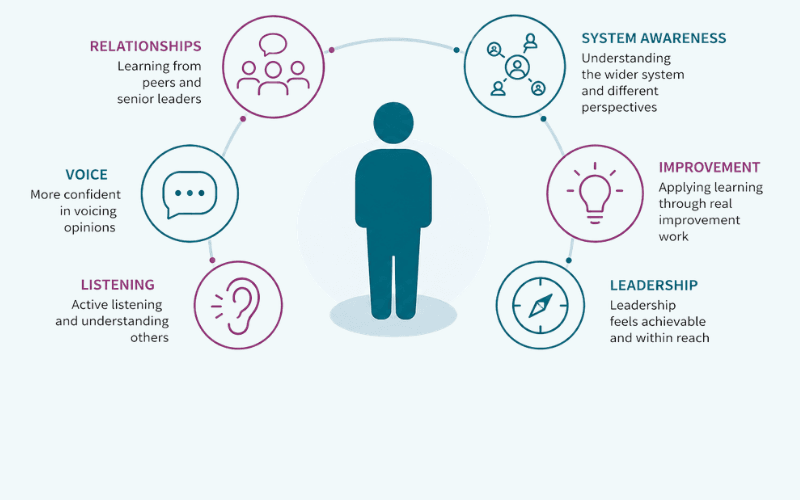
- Greater confidence in contributing ideas and opinions
- A clearer understanding of leadership in practice
- Increased confidence to consider future leadership opportunities
- Stronger relationships with colleagues across the system
- Greater understanding of the challenges faced across organisational boundaries
- Improved active listening and communication skills
- Increased awareness of the importance of stakeholder engagement and collaboration
- A stronger appreciation of adaptive leadership

Key learnings
Through a combination of Action Learning Sets, leadership development and real improvement work, the programme helped him build confidence, broaden his understanding of the wider health and care system and develop practical leadership skills that could be applied immediately in practice.
The experience provided valuable insight into what leadership looks like in reality, helping him recognise that leadership is not reserved for those in formal positions of authority but can be developed over time through reflection, collaboration and experience.
Daniel’s journey demonstrates how leadership development can help individuals build the confidence, relationships and skills needed to influence improvement, work across organisational boundaries and contribute to positive change across the system.
Read more about the SNEE Senior and Aspiring Leaders Leadership Programme here